
5 Things I Know Now As A Pelvic Floor PT That I Didn’t Know 5 Years Ago
Over the past year, I’ve had a number of patients come back to me with second and even third!! pregnancies. Seeing returning patients as they grow their families is absolutely one of the best parts of my job, and over the last year it’s also sparked some reflection on how much my clinical knowledge and opinions have evolved over time.
While I’ve always worked hard to provide the best possible education to pregnant and postpartum folks, I've found myself tweaking the words of my past self for some of my returning patients. As my clinical experience has grown and pelvic health research has grown, what I share and how I share it has changed, too.
Years ago, a colleague of mine said that if she's treating the same way 6 months from now as she is now, something has gone wrong. And I agree with her - as clinicians, our knowledge should be ever evolving.
So, I wanted to share five things with you that I know now as a pelvic floor PT that I didn’t know five years ago, as well as how it has impacted my patient education.
5 things I know now as a pelvic floor PT that I didn't know 5 years ago
Valsalva isn't the same as bearing down.
When I was trained as a pelvic floor PT, we were taught to cue patients to “valsalva” or “push like you’re pooping” during a pelvic exam to assess pelvic organ movement. But thanks to educators like Dr. Christina Prevett and Dr. Antony Lo, as well as my own experimentation with heavy lifting, I now know that's incorrect.
Bearing down is what you do when you hold your breath and generate downwards pressure through your pelvic floor - folks do this when pooping, particularly while constipated, or while pushing a baby out. The idea is that you’re using the pressure in your abdomen to expel something out of your body.
Valsalva, on the other hand, is a technique that uses a breath hold to stabilize the spine. People will do this automatically when lifting a very heavy weight. It's a protective mechanism that, when done correctly, does not generate pressure down through the pelvic floor. Both techniques require a deep breath in and a hold at the top of the breath, but they use the increase in intra-abdominal pressure in very different ways.
Whereas valsalva used to be something I coached my patients to avoid completely, it has become a technique I now talk about extensively with my athletes. We talk about when we may want to utilize the valsalva technique and what their pelvic floor needs in order to coordinate this in a way that serves rather than stresses their bodies.
Postpartum exercise guidelines are even looser than I once thought.
As a physical therapist, this one feels obvious. One of the central tenets of physical therapy is an individualized plan and the belief that there’s no one size fits all approach to rehab, including postpartum return to exercise.
But while I've always believed that return to exercise needs to be individualized, I also had a firm belief that we shouldn't be lifting earlier than 8-10 weeks postpartum and we shouldn't be resuming impact earlier than 10-12 weeks. And while I do still find that this general timeline holds, I'm more comfortable with earlier return to higher intensity activity when appropriate. For example, I’m no longer scared when an elite runner tells me she returned to running at 7 weeks postpartum rather than waiting for my 12 week guideline, although I do still educate on signs and symptoms to look out for that may indicate she’s progressing too quickly.
Activity level during pregnancy, mechanism of birth, birth injury, postpartum support, nutrition and sleep amongst factors like luck and genetics will play a huge role in what return to sport looks like.
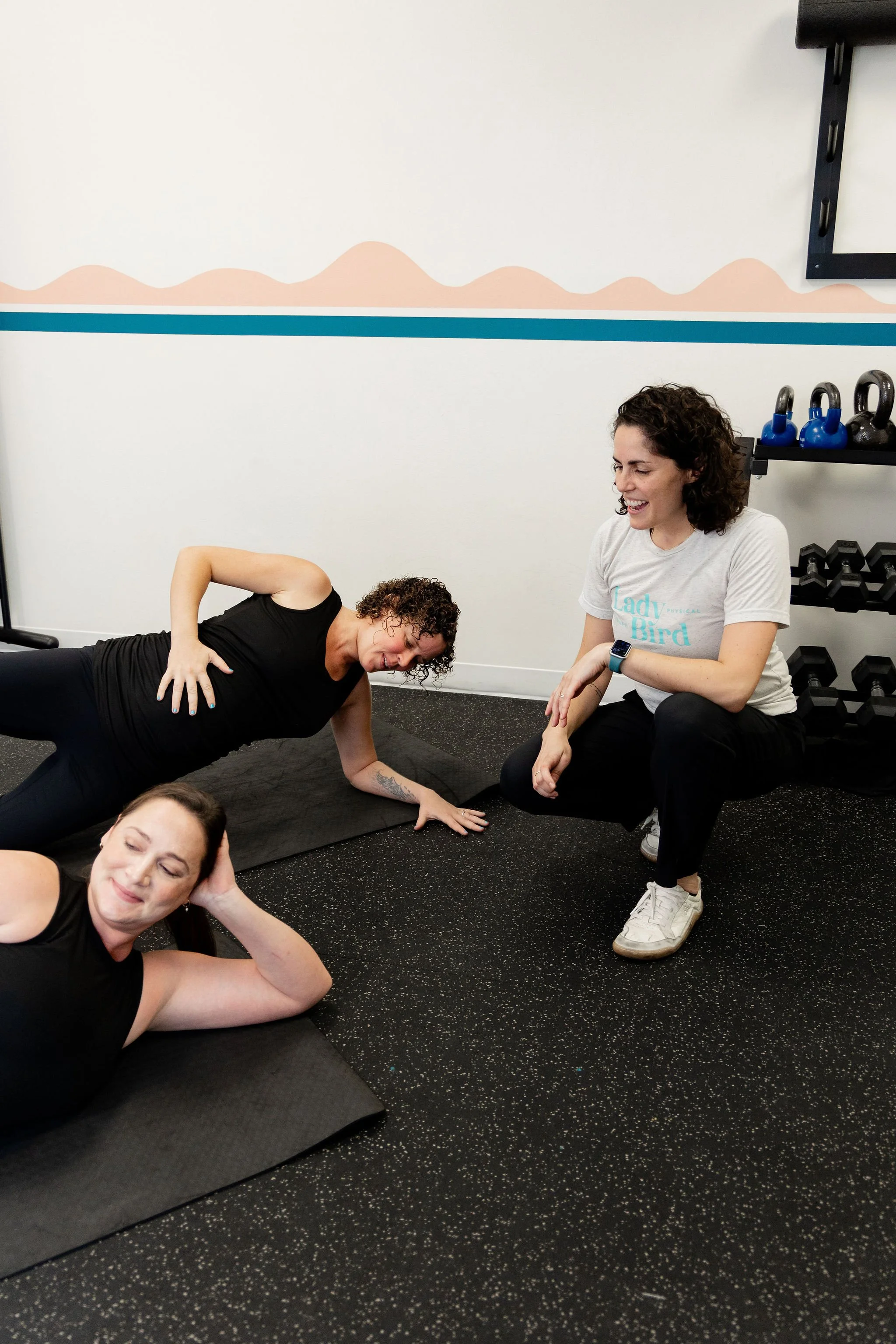
A strong postpartum core isn’t built only in a neutral spine position.
Flexion, rotation, and side bending matter just as much as strengthening your core in a neutral position.
I was trained as a pelvic floor physical therapist at a time when pregnant and postpartum folks were routinely advised to avoid crunching, twisting, and side bending to prevent or worsen diastasis recti. The belief was that these movements placed excessive strain on the linea alba, leading to further tissue injury and weakness. While this advice is still widespread on social media, we now have strong evidence showing that crunches and oblique-focused exercises can actually help narrow the gap rather than worsen it. Current evidence no longer supports avoiding specific movements to “protect” the linea alba and instead supports strengthening the core through its full range of motion.
Training the core through varied movement patterns is functional and essential for building true strength while reducing injury risk in everyday life. Try keeping your spine neutral for an hour while caring for young kids… it’s not realistic. For exercise to be effective, it has to reflect real life. While core work should still be modified to accommodate a pregnant belly or individual postpartum needs, those modifications shouldn’t come from a generalized fear of moving the core beyond neutral.
Perineal massage isn’t about stretching the tissue, it’s about teach you to relax into the discomfort.
Evidence suggests that performing perineal massage starting around 34 weeks of pregnancy can reduce the likelihood of grade III and IV tearing as well as reduce the likelihood of pelvic pain at three months postpartum. I used to believe that this was because we were stretching the tissue, making it more pliable and thus less likely to tear. But if that were the case, we’d expect more to be more, with better results if someone performs perineal massage daily. Instead, we see this positive effect reached when massage is performed 1-3 times a week for 10 or so minutes.
This makes me think that rather than trying to optimally stretch the tissue during pregnancy, we're actually primarily trying to teach you how to relax into the discomfort so when it comes time to push in labor, you're not clenching against the downward pressure. In fact, a 2025 manuscript in the American Journal of Obstetrics and Gynecology concluded that “contracting the muscle as it is stretched by the descending head during a push places increased tension on the muscle origin, thereby increasing the risk of injury.”
In other words, perineal massage may function less like a physical preparation tool and more like a neuromuscular one. It gives you repeated, graded exposure to a sensation that is unfamiliar and uncomfortable, and an opportunity to practice responding by relaxing into the sensation rather than guarding against it. Over time, this can shift your instinctive response from tightening away from pressure to leaning in.
Prolapse symptoms do not always get worse with subsequent pregnancies.
Multiple vaginal births are a documented risk factor for symptomatic prolapse, so it’s understandable that many of my patients with prolapse symptoms fear a subsequent pregnancy or birth. Over the years, I’ve had countless conversations with patients questioning whether their bodies can tolerate another pregnancy or considering a planned cesarean solely to avoid worsening their symptoms.
What I see much more clearly now than I did earlier in my career is that prolapse symptoms are influenced by far more than birth history alone. Tissue health, neuromuscular coordination, strength, pressure management, recovery time between pregnancies, and overall physical and mental health all play meaningful roles in how symptoms present and evolve. Pregnancy itself does not automatically equal progression.
Over the past five years, I’ve seen many patients experience stable, and in many cases improved, prolapse symptoms in later pregnancies, particularly when they enter pregnancy stronger, better supported, and more informed about how to manage load and pressure throughout their pregnancy. While risk does exist, symptom worsening is not inevitable, nor is it the expected outcome when individuals have the time, guidance, and capacity to do the preparatory and supportive work.
In summary
So there it is! Five things I know now that I didn’t know five years ago. None of these shifts came from a single study or continuing ed course. They came from years of listening closely to patients, staying curious, being willing to question old rules, and letting new evidence (and lived experience) shape how I practice. Growth in clinical work doesn’t always mean learning something entirely new; sometimes it means unlearning what felt certain and replacing it with something more nuanced, flexible, and human.
If there’s one takeaway I hope lands, it’s this: bodies are adaptable, resilient, and far less fragile than we’ve often been taught to believe, especially during pregnancy and postpartum. Good care doesn’t come from rigid timelines or blanket restrictions, but from individualized education, thoughtful progression, and trust in the body’s capacity to respond to load when it’s supported appropriately.

This post was written by Dr. Rebecca Maidansky, PT, DPT, owner and founder of Lady Bird Physical Therapy. Rebecca is a pelvic floor physical therapist in Austin, TX and founded Lady Bird Physical Therapy in 2019. She is the creator of Birth Preparation and Postpartum Planning, Baby Steps Fitness and the head writer and editor of The Pelvic Press.
Rebecca is a passionate writer and vocal advocate for pelvic health and the importance of improving access to perinatal care. She believes strongly that many common pregnancy pains and postpartum symptoms can be eased or even prevented with basic education and care.